Language of longing
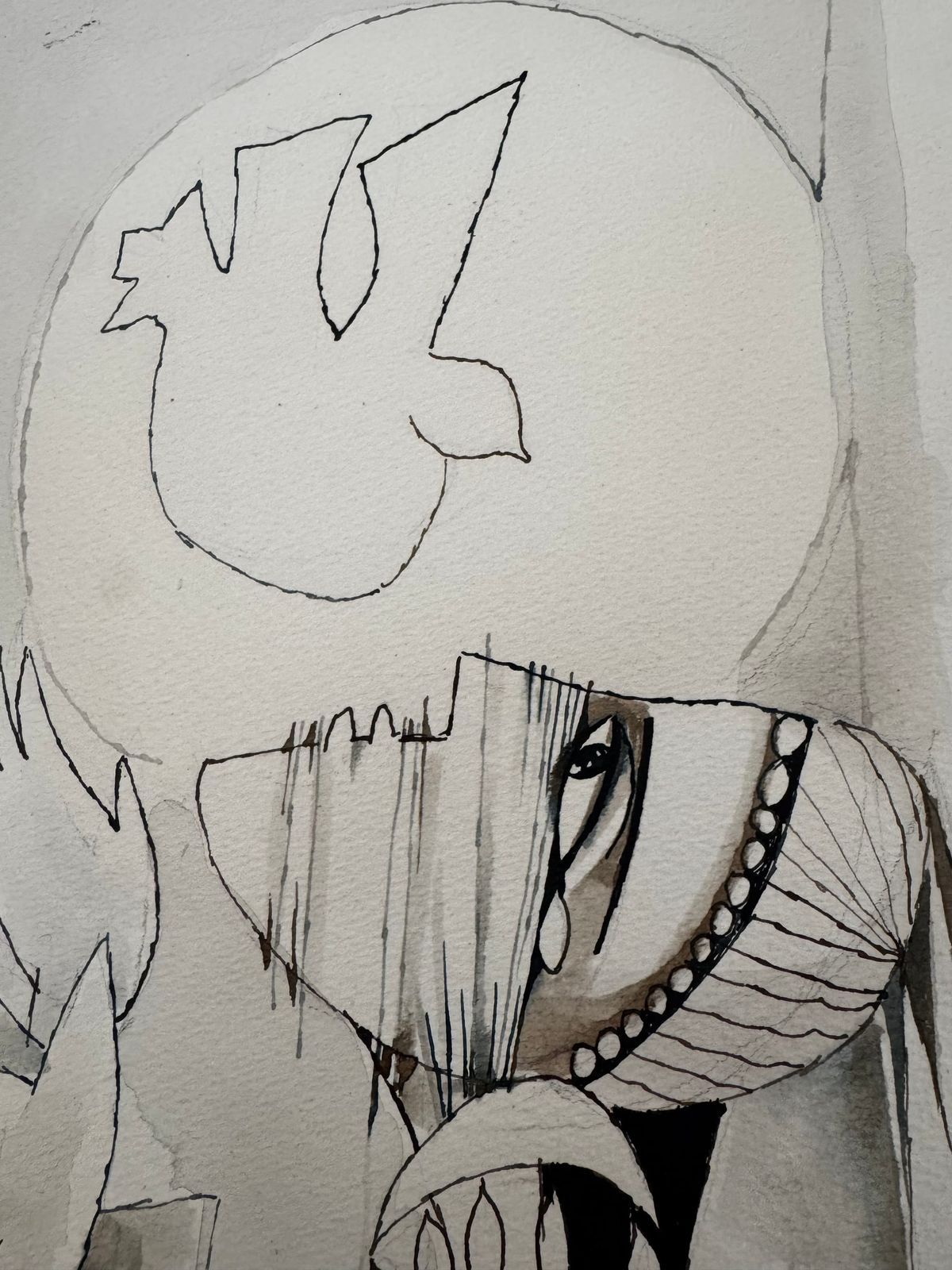
In my childhood home, an ink drawing and poem by the Palestinian artist Kamal Boullata hung in our hallway.
It was the only piece of original art my parents owned. It depicts a woman holding her hands out and gazing at a peace dove, a fat bird in this drawing with puny wings that made flight seem impossible. Under the image, in Boullata’s handwritten calligraphy, is the poem, a love song to Palestine, an ode of longing and of reunion.
I think of that picture now as I contemplate the slow, agonizing process of claiming myself as a woman of Palestinian, Syrian, and Turkish ancestry. The longing for place—a place that confers a sense of a self without the conflict that attends displacement, a peaceful self that doesn’t feel a demand to justify its existence—feels deeper, feels like those outstretched hands longing for reunion. A falling into place that comes with ease.
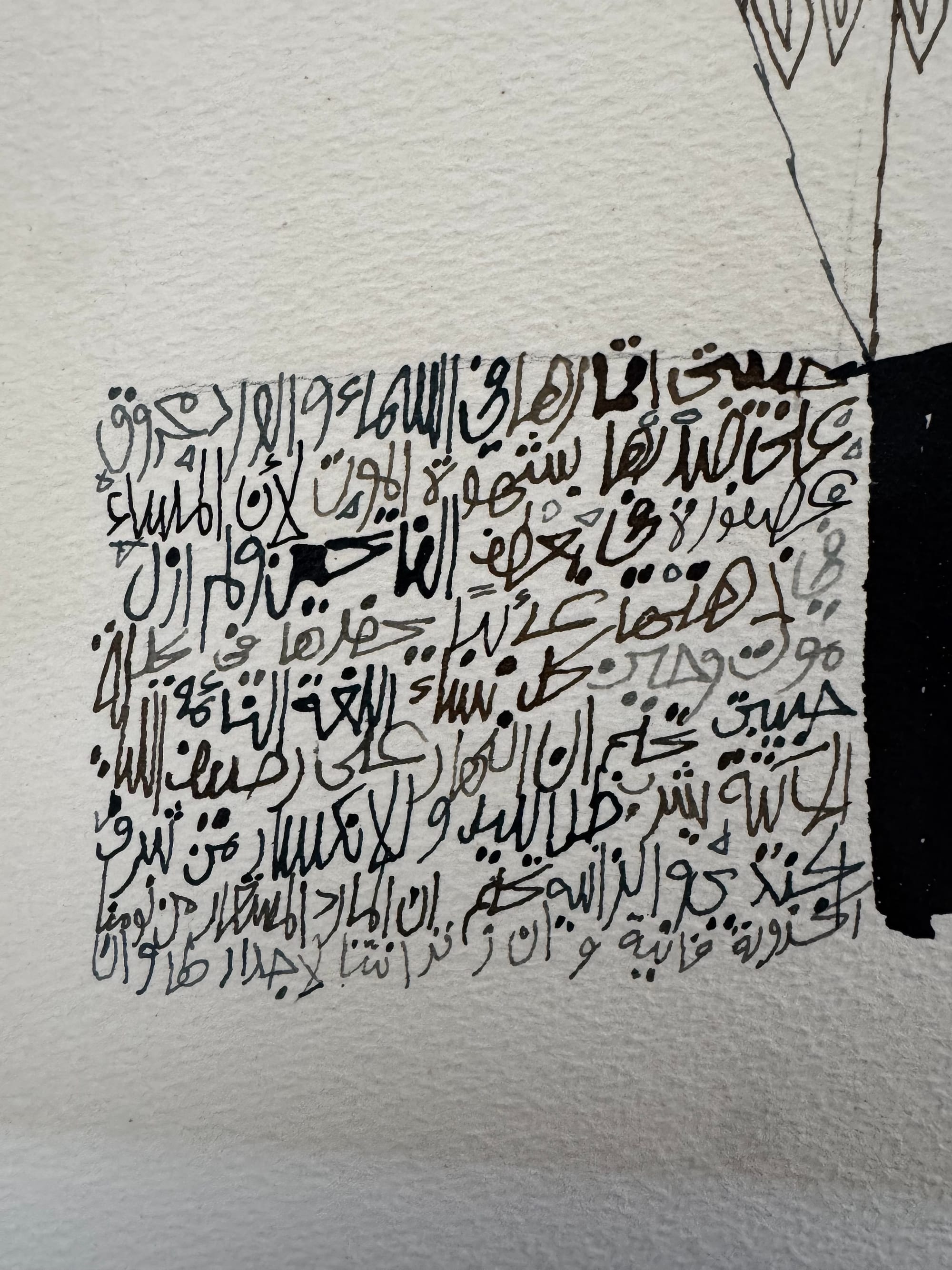
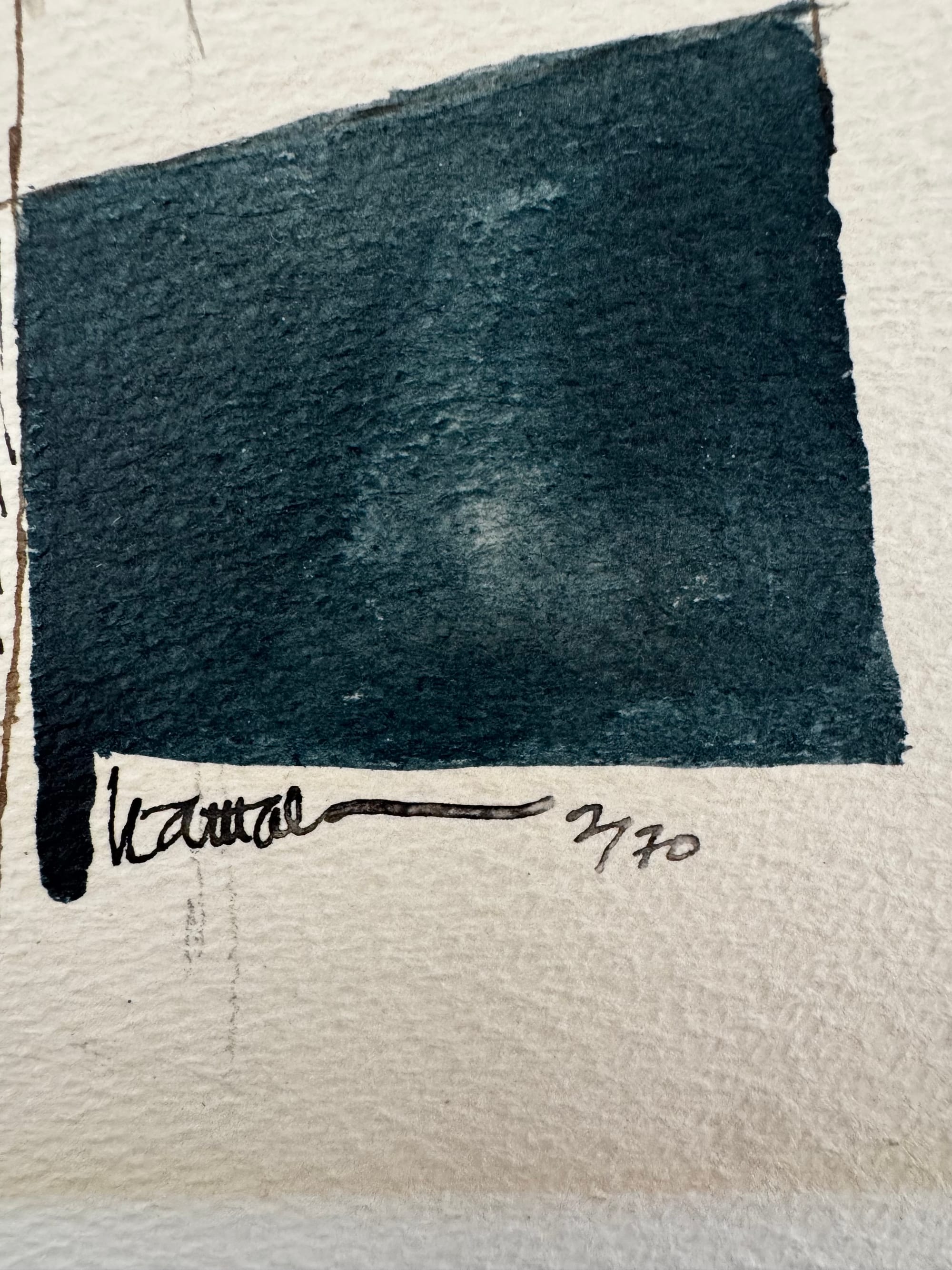
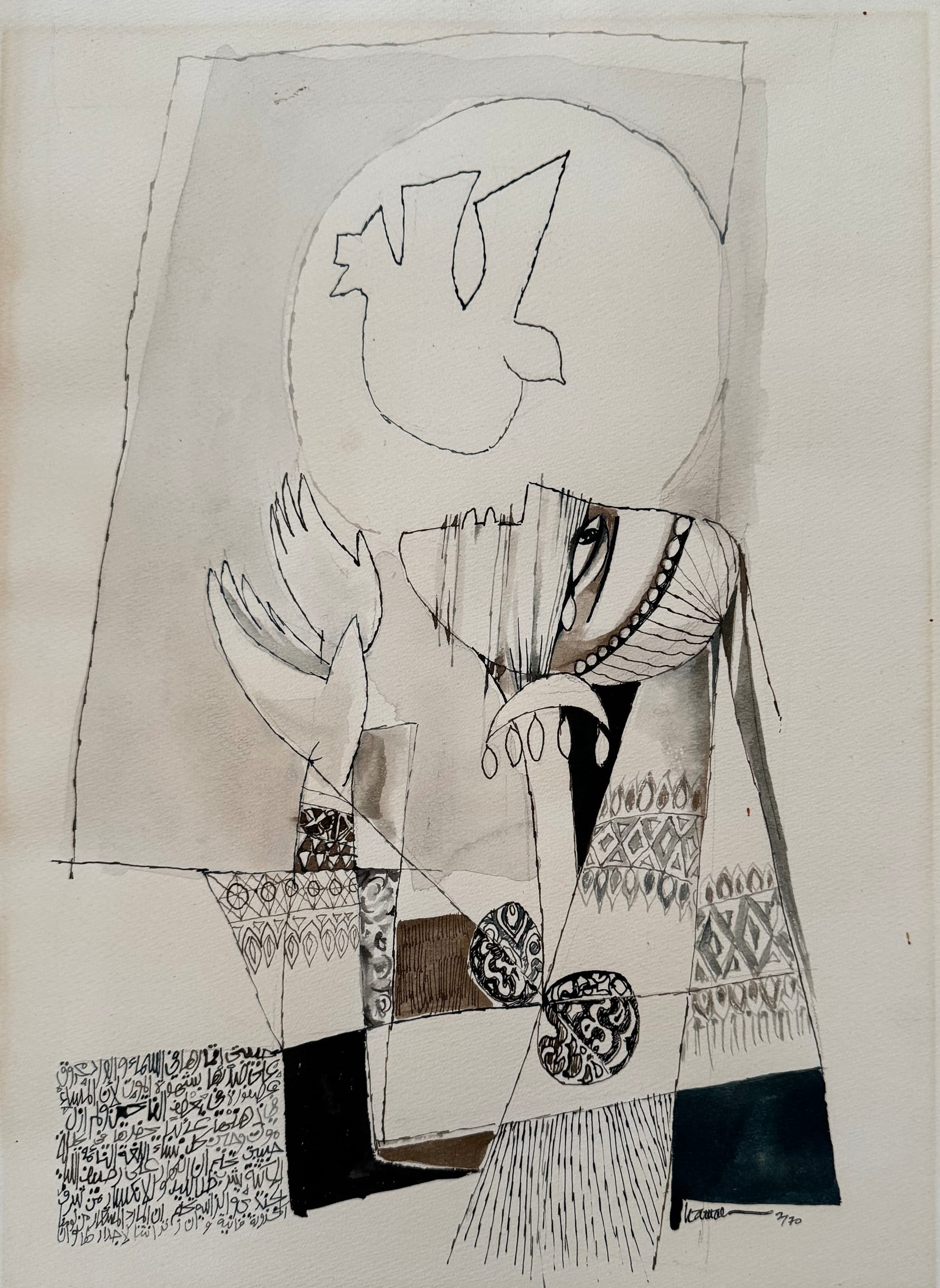
Original artwork by Kamal Boullata, 1970
I’ve felt this briefly on trips to visit family in Türkiye, but I want it to be permanent. I want that longing to feel met within me.
I have been slowly teaching myself Arabic. Not the vernacular that I heard my parents and extended family speak, but written and read Arabic. I am entirely at sea as I do this. If my mother’s excuse for not enrolling us in lessons was that there were few options to do so—an excuse to cover her complacent mothering—now there are so many it’s difficult to settle on a method. Best practice is to be immersed, which means going to an Arab country. I know I will need to do this at some point if I’m serious about filling this necessary gap: the one that separates me from the literature and art that is actually my birthright. All of the culture that could help me truly learn about where my people are from, the missing parts of what I am. Translation feels uneasy to me, the strangeness of needing a third party to mediate between selves at starkly opposite ends of development. That unknown self is still me, and I’ve been able to treat it like a stranger for too long. It makes me ashamed, like a relative hidden in an attic.
Sometimes, I surprize myself: I memorize the alphabet and begin to recognize characters. Driving around, I spot the Arabic characters forming the English word m-a-r-t, and feel a sense of gleeful recognition. It’s humbling at 50 to have the same joy as a child learning to read for the first time. These moments provide a spontaneous sensation of flight, like flight itself wasn’t that outlandish to contemplate, despite my mother’s litany of complaints about how difficult Arabic was to learn. She felt the pressure to please her father and pass exams; I have only myself to please.
Judging by their neglect—how they never bothered teaching us, how they even discouraged us dating Arabs—my parents never cared how Arab we were, or wanted to be; an ambivalent gift, because no one ever asked you what you wanted. They often did things from a place of reaction, of overcorrection, never of a fulsome sense of what makes a person whole. Which leads me to think they never even considered wholeness as a worthwhile endeavour. Or maybe their wholeness, requiring less consideration, needed less just to exist.
I have no such luck. I need help.
When I finally settle on a program of Arabic learning, it’s with a tutor who immediately makes me feel at home. She is from my mother’s country, so I am not simply learning Arabic; I’m rediscovering origins, meaning that was buried within me. When I meet her for the first time, I have an immediate sense of being in the right place at the right time, all worries about delay falling away. She is cheerful as she tells me not to be concerned about making mistakes, just to do what feels intuitively right. This way of thinking about the language resonates with me; I’ve gathered more than I realized from hours spent listening to my aunts, for example. I’ve always understood more than what I was able to spit out on the spot. The work now is to build myself internally, to build Arabic and my sense of myself as an Arab from within. I am relying on the language to guide me, and eventually everything written, spoken, sung in Arabic. I look forward to each lesson, an eager student.
When my mother asks about my Arabic lessons, I can tell she has a quiet sense of pride in me for taking the initiative to do this. There is a palpable glee in her that I can sense, of having succeeded in some way: she has planted the desire for me to see this part of myself be fleshed out without her having had to push for it. Maybe that was her goal all along: not to insist on something I didn’t want, but to leave it up to me to decide. Where she had been pushed, pressured, she wanted me to figure it out for myself, and only then would she show encouragement. I wish she’d have guided me a bit more when I was younger, but now the determination is all mine, the motivation for it is deeply felt.
Once I feel the edifice of Arabic growing within me, Turkish will be next.